Key Takeaways:
- Choose a screw and nut lift if you want less builder’s work, a smaller pit, lower headroom requirements and a better fit for tighter spaces
- Choose a hydraulic lift if you want a faster, more conventional lift feel and the building can accommodate a full shaft, deeper pit and more headroom
If you are comparing screw and nut lifts with hydraulic lifts for either commercial or residential applications, the biggest differences are usually the amount of building work required, the pit and headroom needed, how the lift operates, and how automatic you want it to be.
A screw and nut lift is generally the simpler option from a building point of view. It is a platform lift that comes with its own shaft, so you do not need a full structural shaft built before installation. We just need to be able to attach it to the landings. They also only need around a 50 mil pit and very low headroom, so they can work really well where space or building constraints are a factor.
A hydraulic lift is a different setup. On the residential side, we are generally talking about a roped hydraulic system. These need more builder’s work up front because the full structural shaft needs to be constructed before we start. They also need a deeper pit, roughly 160 to 200 mil, and more headroom on the upper level. So if you are going down the hydraulic path, the house or the build needs to suit it properly.
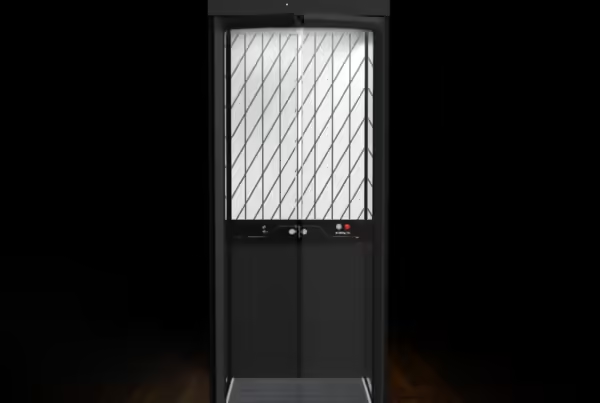
In terms of operation, a screw and nut lift is generally a constant pressure lift. So you keep the button pressed and the lift does what it needs to do. A hydraulic lift, especially a sliding door option, gives you a more conventional lift feel. It is more automatic, and if it is a sliding door product, it is a fully enclosed cabin, so you cannot see anything as you are travelling up in the lift. That is one of the reasons people tend to favour them when they have got the room and the building setup to suit it.
Speed is another difference. The hydraulic lifts travel roughly twice the speed of the screw and nut system, so they do feel a bit more like a traditional passenger lift in that sense. If someone wants that smoother, more conventional experience, that is often where the hydraulic product starts to appeal more.
Installation preparation is different as well. With a screw and nut lift, we are doing a lot of that ourselves because the product comes with the shaft. With a hydraulic lift, the builder needs to make sure the shaft, pit and structural work are all done before we commence. So one is generally more forgiving from a construction point of view, while the other relies more heavily on the building being fully prepared.
Even the install time can differ a bit. On a generic two stop residential lift, a hydraulic sliding door lift might be roughly two weeks on site from start to finish commissioning, whereas an Aritco screw and nut lift is more like a week to a week and a half.
So really, if you want less builder’s work, a smaller pit, lower headroom requirements and a product that can work well in tighter spaces, a screw and nut lift is usually the better option. If you want a faster, more conventional, fully enclosed lift feel and the building can accommodate the extra pit, headroom and shaft requirements, then a hydraulic lift is generally the better fit.
Key Points
- Screw and nut lifts need less builder’s work because they come with their own shaft and do not need a full structural shaft built first
- Hydraulic lifts need more building preparation including a full structural shaft, a deeper pit and more headroom
- Screw and nut lifts suit tighter spaces better because of their lower pit and headroom requirements
- Hydraulic lifts give a more conventional lift feel especially with a fully automatic sliding door setup
- Hydraulic lifts are generally faster than screw and nut lifts
- Screw and nut lifts are usually constant pressure lifts, while hydraulic lifts can offer a more automatic operation
- Installation is generally simpler with a screw and nut lift, while hydraulic lifts rely more on the builder having everything ready before work starts
- The best option comes down to the space available, the level of builder’s work involved, and how you want the lift to operate